Dental Crowns & Bridges in Munford: Repairing Damaged Teeth and Replacing Missing Teeth
August 17, 2026 7:00 amA tooth does not have to be missing before it starts changing the way you eat. A large old filling can leave the surrounding tooth thin, while a crack can make chewing on one side uncomfortable. If a corner breaks away, you may find yourself avoiding that tooth without really thinking about it. Pretty soon, anything crunchy seems to migrate to the other side.
If the tooth can still be saved, a crown may protect what is left and rebuild the chewing surface. If the tooth is already gone, however, a bridge may be used to replace the space. At Southern Dental Munford in Munford, TN, Dr. Cheryl Bird looks at the tooth itself, but she also checks the nearby teeth and the way the bite comes together before recommending treatment.
For example, a cracked molar with a large filling may need a crown because another filling would leave too much weakened tooth around it. A missing tooth between two heavily restored teeth may fit well with a bridge instead. However, if the neighboring teeth are healthy and untouched, another replacement option may make more sense.
What Is a Dental Crown?
A dental crown covers the visible part of a damaged tooth. It restores the shape of the tooth and gives you a solid chewing surface again. The natural tooth stays underneath, while the crown is cemented over it.
Crowns are often recommended when a filling would leave too much unsupported tooth around it. That can happen after a large cavity, repeated fillings, a crack, or years of wear. In addition, they may be used after root canal treatment, especially on back teeth that take heavier chewing pressure.
If most of a molar is already filling material and only thin walls of natural tooth remain, another filling may not provide enough support. So instead of filling the center again and leaving those outer walls vulnerable, a crown covers the tooth from the outside. Because of that, the remaining structure has more support each time you chew.
When a Crown May Be Needed
A very large filling can hold up for years and still leave the tooth around it more vulnerable to cracking. Sometimes the filling itself is fine, but a corner of natural tooth breaks away beside it. And it does not always happen while chewing ice or something especially hard; sometimes lunch is completely ordinary and the tooth still gives out.
Cracked teeth can also be inconsistent. You may chew normally through most of a meal, then suddenly feel a sharp jolt when you hit one exact spot. If the crack has not gone too far into the root, however, a crown may help hold the tooth together and reduce movement in those weaker sections.
Grinding and clenching can wear teeth down in a different way. Over time, the chewing surfaces may flatten, small chips may appear, and older fillings can start taking more pressure too. Once enough structure is gone, a crown can rebuild the tooth and restore a more even chewing surface.
What Is a Dental Bridge?
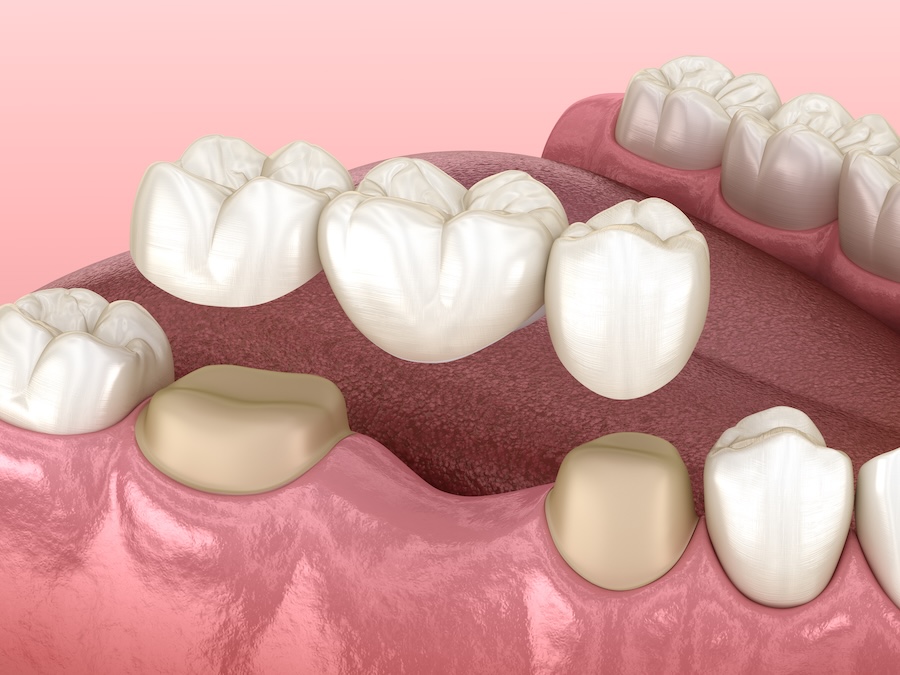
A dental bridge replaces one or more missing teeth with a fixed restoration. A traditional bridge usually uses crowns on the teeth beside the gap, with a replacement tooth attached between them. Once it is cemented in place, the bridge stays in your mouth.
For many people, the missing tooth becomes most noticeable during meals. Food gets lodged in the same space, firmer foods get moved to the other side, or one side of the mouth starts doing more of the work. Then, after a while, you may be halfway through dinner before you realize you have been chewing almost entirely on one side.
A bridge fills the gap and gives that area a chewing surface again. At the same time, it can help limit gradual movement of the nearby teeth. If the space has been open for a while, though, Dr. Bird will also check whether those teeth have already shifted.
The Teeth Beside the Gap
A traditional bridge depends on the neighboring teeth for support. Because of that, Dr. Bird checks whether those teeth are stable and whether they already need crowns for their own reasons. One may have a large filling, while the other may have very little dental work.
If both neighboring teeth already need crowns, using them to support a bridge may fit well with that treatment. However, if both are healthy and untouched, preparing them for crowns is a bigger step. In that situation, a dental implant may be another option to compare.
The gums and bone around those teeth also need to be healthy enough to support the bridge. A loose tooth or one with significant gum disease may not be a good anchor. So, before the bridge is planned, Dr. Bird checks the support around those teeth as well.
How Crowns and Bridges Affect Your Bite
A crown has to do more than cover the tooth. It also has to meet the opposing tooth at the right height and angle, because even a small high spot can become very noticeable once you start chewing. If one tooth seems to arrive at the bite before everything else, it can get sore pretty quickly.
A bridge works the same way in that respect, except the replacement tooth is connected to the supporting teeth beside it. Because of that, the bite needs to feel even across the whole restoration. If the replacement tooth takes too much pressure, the area can start feeling uncomfortable.
So before the crown or bridge is finalized, Dr. Bird checks how everything comes together when you bite. Then, if one area feels high or tight, she can adjust it. Once the numbness wears off, the restoration should feel like it belongs with the rest of the bite.
Missing Teeth Can Affect Nearby Teeth
After a tooth is lost, the teeth around the gap can start to move. The teeth beside it may tilt inward, while the tooth above or below may drift because it no longer has an opposing tooth to meet. These changes usually happen slowly, so the first sign may be something as simple as food catching in a new place.
Meanwhile, the bite may start feeling different on one side. And if the tooth has been missing for years, the space may even be narrower than it was originally. By then, Dr. Bird has to look at how much room is left before deciding what kind of replacement will fit.
A bridge can fill the gap and help limit further movement. However, if the surrounding teeth have already shifted quite a bit, that has to be accounted for first. In some cases, the amount of room left changes which replacement options are still possible.
What Happens During Treatment?
For a crown, Dr. Bird removes decay, damaged material, or old restorative material that needs to come out. Then the tooth is shaped so the crown can fit over it, and impressions or digital scans are taken. After that, a temporary crown usually protects the tooth while the final one is being made.
A traditional bridge follows a similar process, but the teeth on both sides of the gap are prepared because they will support the replacement tooth between them. A temporary bridge may be placed while the final restoration is being made. Since temporary dental work is not as strong, however, gum, taffy, and anything especially sticky are best skipped for a little while.
A temporary crown or bridge can come loose more easily than the final one, so this is a good time to be a little more careful with what you chew. Then, when the final restoration is ready, Dr. Bird checks the fit, the contact with neighboring teeth, and the bite. If something feels high or tight, it can be adjusted before the restoration is cemented.
How Crowns and Bridges Can Blend With Your Smile
Crowns and bridges are made with tooth-colored materials chosen to blend with the surrounding teeth. Shade is part of the process, but shape, contour, translucency, and edge detail all affect how natural the restoration looks. Dr. Bird excels at this artistry side of dentist and knows those details become especially noticeable on teeth that show when you smile.
Real teeth are not identical copies of one another. One may be slightly more translucent near the edge, while another has a softer contour or a small difference in texture. Because of that, a restoration usually blends better when those variations are carried into the final result.
Dr. Bird compares the new restoration with the teeth around it before it is finalized. For example, a front crown may need a slightly softer edge or a different contour than the tooth beside it. The finished tooth should fit naturally with the rest of the smile instead of looking overly uniform.
How to Clean Crowns and Bridges
A crown is brushed and flossed much like a natural tooth. The crown material itself cannot get a cavity, but unfortunately the tooth underneath still can. So the edge where the crown meets the tooth still needs regular cleaning.
A bridge takes a different flossing technique because the replacement tooth is connected to the crowns beside it. Regular floss cannot drop straight down between those connected pieces, so instead it has to be guided underneath from the side. A floss threader, small interdental brush, or water flosser can usually reach that space.
The first few tries can feel a little clumsy, especially if you have never cleaned under a bridge before. However, the motion usually gets easier once you find the tool that works best for the space. After that, it becomes a much more normal part of the routine. We wouldn’t recommend skipping it, because dinner likes to hide under bridges and can increase bad breath.
How Long Do Crowns and Bridges Last?
Crowns and bridges can last for many years, although there is no set replacement date. How long they last depends on the teeth underneath, the gums, the bite, home care, and how much pressure the restorations take. Grinding and clenching can shorten their lifespan too.
If you wake up with a tired jaw or have a history of broken fillings, chipped teeth, or worn enamel, bring that up with Dr. Bird. She may recommend a nightguard to reduce some of the pressure while you sleep. At the same time, regular exams give us a chance to check the edges, gums, and supporting teeth before something starts feeling loose or painful.
When a Crown Cannot Save the Tooth
Some teeth are too damaged to support a crown. A crack may extend too far below the gumline, decay may have destroyed too much structure, or the tooth may have broken in a way that cannot be rebuilt reliably. In those cases, extraction may be necessary.
If the tooth has to come out, a bridge may be one option for the space. However, a dental implant or removable partial denture may also be considered, depending on the location of the tooth, the neighboring teeth, and the available bone. Dr. Bird can compare those choices based on what is present in the area.
A tooth that keeps chipping, breaking, or hurting with pressure should be checked before more structure is lost. Sometimes there is still enough left for a crown. Once the damage extends too far, however, that option may no longer be available.
Bridge or Dental Implant?
To sum, a bridge and a dental implant can both replace a missing tooth, but they are supported differently. A bridge uses the teeth beside the gap, while an implant is placed in the jawbone and supports its own crown. Because of that, the condition of the nearby teeth often influences which option is considered first.
If the neighboring teeth already have large fillings or need crowns, a bridge may fit well with treatment they already need. However, if those teeth are healthy and untouched, an implant may be more appealing because they can stay as they are. Then there is treatment time: a bridge is usually completed sooner, while an implant needs surgery and a healing period in the bone.
Cost, healing time, surgery, cleaning, and the amount of available bone also factor into the choice. So if both options are realistic, our team can go through the differences with you. Some patients prefer the shorter bridge process, while others prefer replacing the tooth without preparing the neighboring teeth.
Dental Crowns and Bridges at Southern Dental Munford in Munford, TN
If you have a large old filling, a cracked tooth, a broken corner, or a missing space that has changed how you eat, schedule a visit with Southern Dental Munford. Dr. Cheryl Bird can examine the area and see whether a crown, bridge, or another treatment fits what is going on. Maybe one tooth only complains when you bite something firm, or perhaps food has been collecting in the same gap for months.
If you are considering a crown or bridge, schedule an appointment with Southern Dental Munford in Munford, TN. We can take a closer look, explain what is happening, and go through the options with you. We’d be glad to help you get that tooth or missing space taken care of!
Categorised in: Dental Bridges, Dental Crowns